MNTN - AI Implementation Strategy
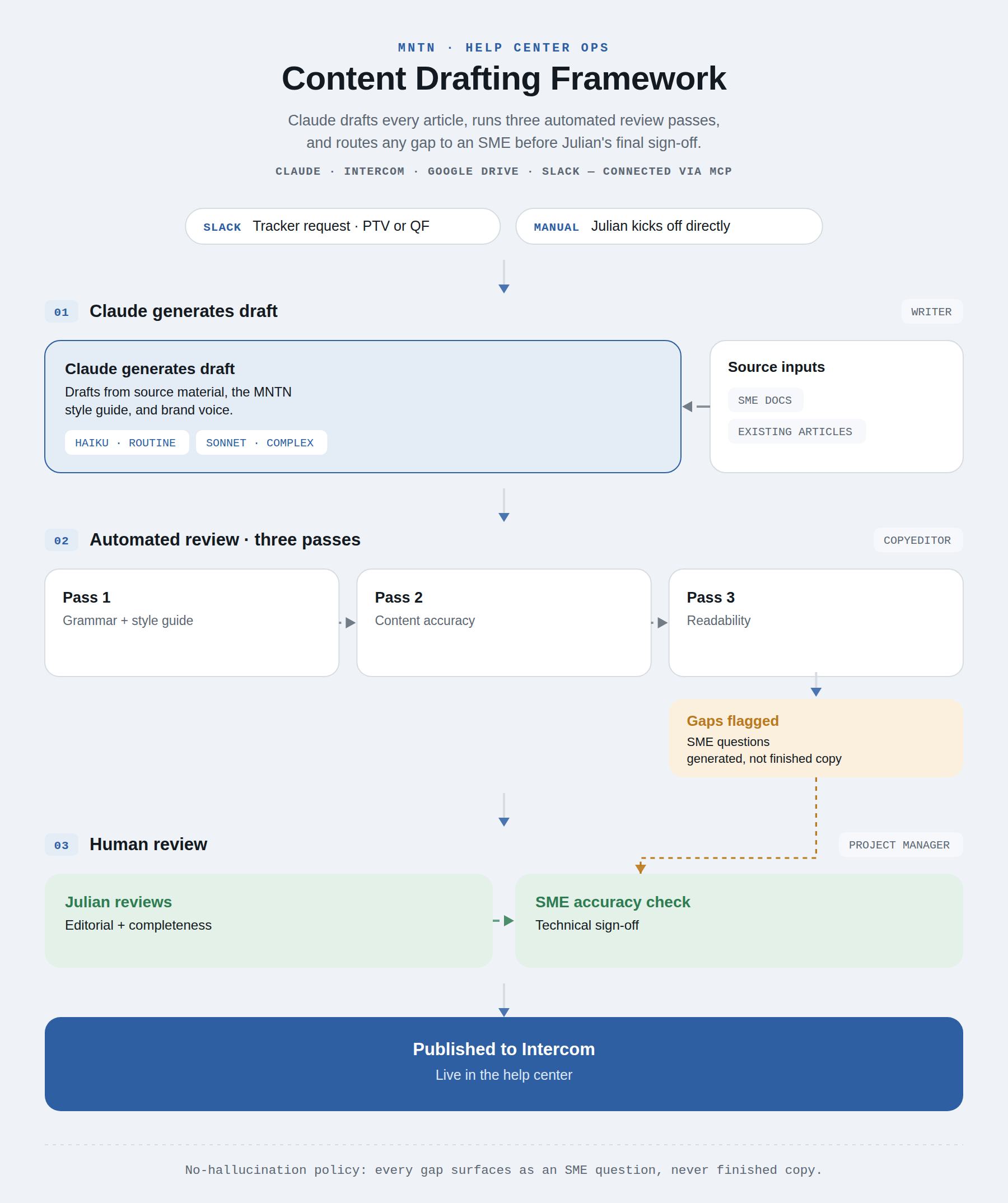
Designed and built a three-skill AI content pipeline, Writer, Copyeditor, and Project Manager, that lifted chatbot resolution from 51 percent to 62 percent and accelerated draft production 48 percent, with a companion reporting agent covered in its own project.
AI-assisted content drafting pipeline for a CTV ad-tech help center's AI chatbot and article production.
Context
MNTN's support team runs Fin, an AI chatbot, as the first line of response for help center queries. Fin's resolution rate is a direct function of article quality: missing coverage, outdated phrasing, or inconsistent structure show up as live-agent escalations.
At 8 to 15 new content requests a week across six SME teams, with 172 published articles to keep current, closing that gap through manual review alone wasn't sustainable.
I designed and built a modular AI agent system using Claude and Claude Cowork, connected to Intercom, Slack, and Google Drive through MCP, to handle the repeatable parts of the content lifecycle so my own editorial judgment could stay on strategy, accuracy, and publish decisions rather than coordination.
My approach
Map the content lifecycle
Identified every repeatable task in the content workflow, including request intake, status tracking, drafting, SME review, editing, and stakeholder reporting, then evaluated which stages were bottlenecks suited to AI augmentation versus which required human judgment.
Build a modular skill architecture
Designed each AI agent as a standalone skill with a hardcoded output format, strict numbered steps, and explicit escalation paths for edge cases. Modular design meant skills could be used individually or chained, so a content request could flow from aggregation to drafting to reporting in a single session.
Connect to live data sources
Integrated skills with live Slack Lists trackers, Google Drive style guide documents, and Intercom article records, giving each workflow access to current data rather than static snapshots. Resolved a root-cause data access issue where Slack Lists require CSV export because direct channel reads do not return list rows.
Embed guardrails at the skill level
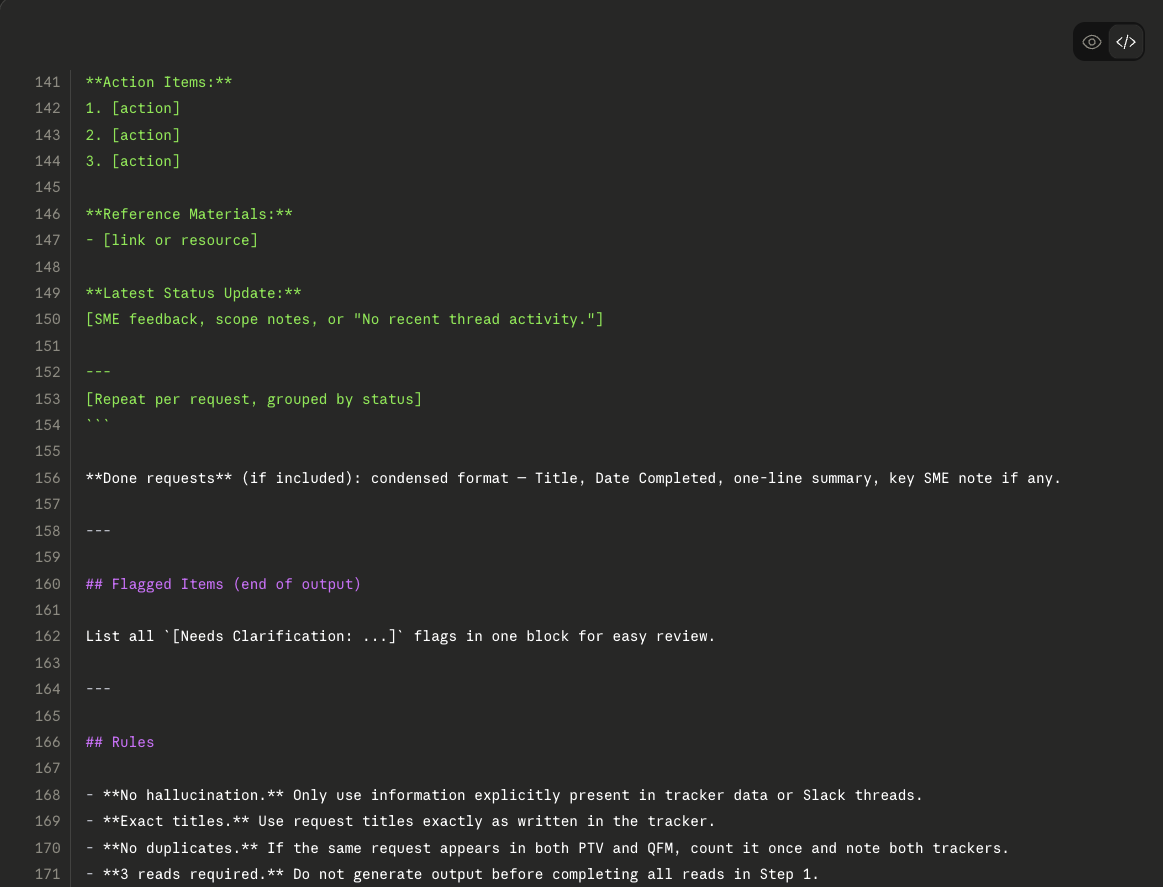
Wrote no-hallucination policies, SME escalation triggers, and source-tracing requirements directly into each skill's instructions, ensuring AI-generated content met editorial standards before any human review step, not after.
Collaboration
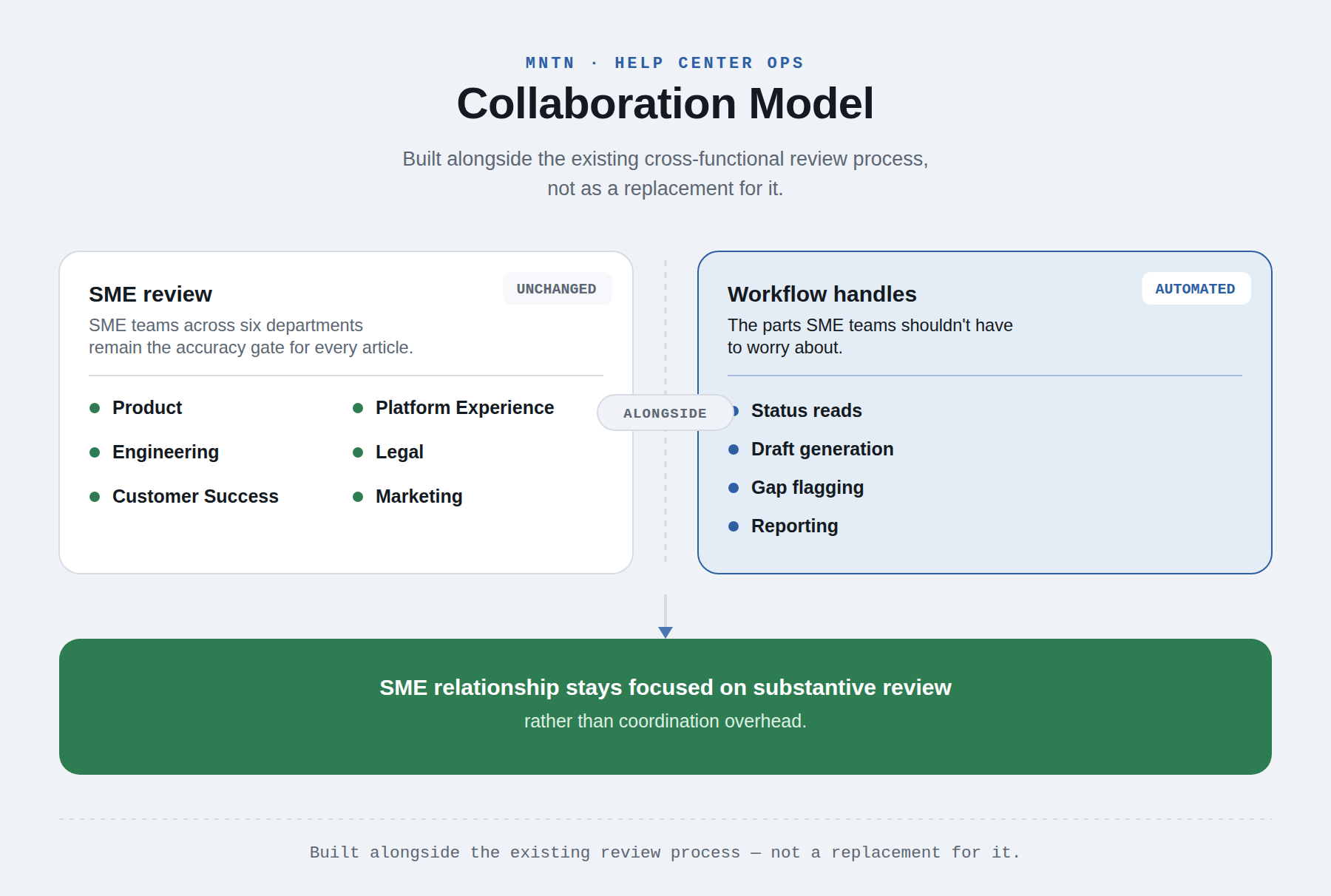
The AI workflow system was built alongside the existing cross-functional review process, not as a replacement for it. SME teams across Product, Engineering, Customer Success, Platform Experience, Legal, and Marketing departments remained the accuracy gate for every article.
The workflows automated the parts they should not have to care about:
status reads
draft generation
gap flagging
reporting
That kept the SME relationship focused on substantive review rather than coordination overhead.
Results
Chatbot resolution rose from 51% to 62% over two quarters. Fewer conversations escalated to live support. I tracked progress in Intercom's Fin AI Agent Performance dashboard and used Fin's per-article content report to point the pipeline at the articles that weren't closing the loop, so rewrites went where customers were actually getting stuck.
Drafting got 48% faster. The Writer skill turned each trigger into a brand-aligned first draft. Model routing kept simple requests on a lighter model and saved the stronger model for complex ones, and three automated Copyeditor passes (grammar, accuracy, readability) cleared routine fixes before anything reached a person.
A queue of 8 to 15 requests a week moved without adding headcount. The Project Manager skill routed flagged drafts to the right SME through Slack, pulling from an SME database in Google Drive, so reviewers only saw work that needed their expertise.
Editorial judgment stayed in the loop. Every draft passed my own review and an SME accuracy check before publishing. The pipeline scaled output across two help centers with a total of 172 articles, without lowering the quality bar.